Websites. Apps. Automation. AI.

Websites and systems. Built to fit.

I am Alexander G. I build websites and web apps and connect the tools you already use. I can also integrate AI, including chat assistants that answer your customers. One developer from the first message to handoff, at a fixed price.

Agencies can hand me a bounded piece under their direction: send the task, the stack and the deadline. See what an agency gets back at handoff

What I build. One example of each kind.

Working demos I built, with invented data.

Websites.

A clear site that says what you do and how to reach you, hosted in your own account.

The top of a bicycle repair workshop's home page under a dark demo notice: its name, menu, phone number and Book a service button, the headline Bike servicing and repairs in Marrowby over a short description on dark green, a photograph of hands fitting a part to a black bike frame, and the top of the opening hours card. Open the site

A small business website.

Four pages for a bicycle repair workshop: services with prices, opening hours, directions and a booking request form.

Look at the booking request, from choosing a service to the thanks page.

Tell me about your business

HTML, CSS and Netlify Forms.

Apps and systems.

Portals, internal tools and staff consoles that replace a process run on forms, spreadsheets and inboxes.

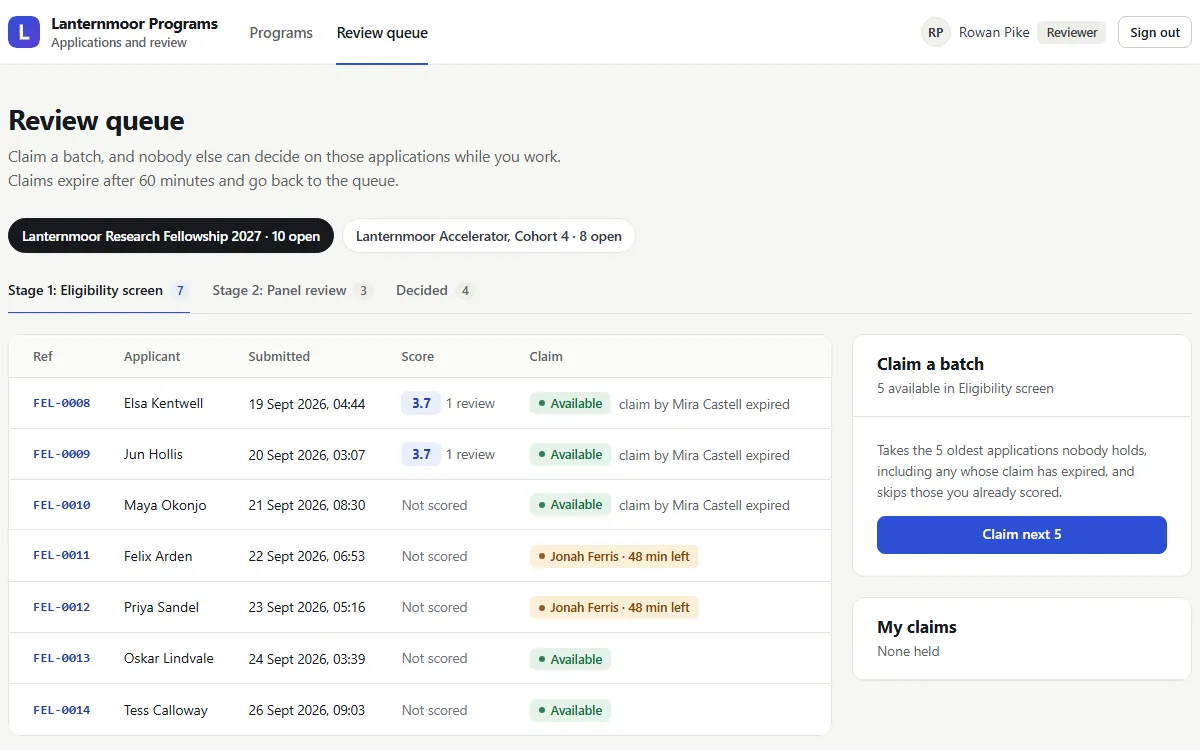
A reviewer's view of a research fellowship's review queue: the program and stage tabs, the eligibility screen's seven applications in seven rows with their scores and claim status, two held by another reviewer with 48 minutes left, and a panel to claim the next five. Watch the walkthrough

An application and review portal.

Applicants fill in one form and see where they stand; reviewers claim applications from a shared queue and decide in stages.

Look at the 77-second walkthrough: an applicant applies and sees the status, then a reviewer claims the application, scores it and decides.

Tell me about your process

Next.js, TypeScript and PostgreSQL.

Automation and integrations.

The tools you already use, connected through their APIs, with background jobs for work repeated by hand.

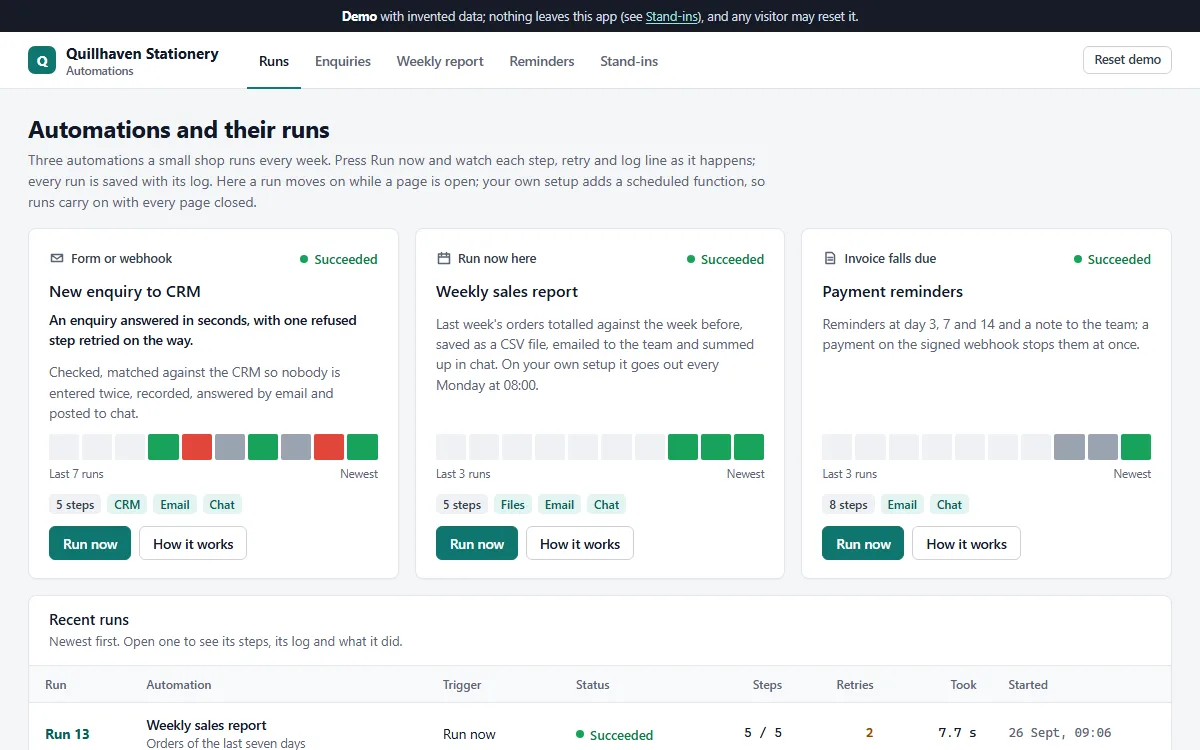
The runs page: three automations, a new enquiry to the CRM, a weekly sales report and payment reminders, each with its last runs as coloured squares and a Run now button, above a table of recent runs with their steps, retries and time taken. Watch the walkthrough

Automations with a run log.

An example enquiry, weekly report and reminder sequence, each step run, retried and logged against sample email, CRM and chat services.

Look at the 65-second walkthrough: an enquiry arrives, each step runs, the CRM refuses once and the retry goes through, and the log shows it.

Tell me what you use

Next.js, TypeScript and PostgreSQL.

Built before.

  • An application and review portal for an online creator community's events: questions set per event, batch claiming, two review stages and automatic access for accepted applicants.
  • A staff applications portal for a studio's online community: applications with questions set per role, staged review and automatic roles for accepted applicants.
  • A quiz platform with prize balances: the players' app, a database where each player reads only their own balance and transactions, each recorded once, and a staff console for fraud flags and prize runs.
  • My own larger system: it finds income-generating projects, tests each against real demand before building it, runs the ones that pass and improves them, with a dispatcher that gives AI agents bounded tasks and has another agent check each result.

How a project runs. You talk to the person who writes the code.

  1. Written scope, fixed price.

    You get both before any work starts.

  2. A first working part in ten days.

    On a test link within ten days of the agreed start, once the deposit is in and you have sent what the scope lists, with a written update every Friday.

  3. You own the code and every account.

    At handoff, with notes another developer can follow.

  4. 30 days of fixes.

    Anything failing the agreed checklist is fixed free; after that, changes come under a care plan or hourly support, priced in the scope.

You supply the text, images and accounts in your name, each by a date the scope sets.

Questions.

How much will it cost?

The written scope fixes the price before work starts; any later change is priced before it is built.

How long will it take?

The scope gives a start date and a launch date, from the hours your project needs and the time I have free.

Who owns it, and what if you disappear?

You own the code, repository and hosting accounts once the final payment arrives, apart from general parts not specific to you, with written steps any developer can follow to run, restore and deploy it.

More questions
What does it cost to run?

The scope lists every service, its free plan's limits and what it costs above them, a busy closing day included, before you agree. Small programs often fit the free plans.

How is applicants' data protected?

Permissions are checked on the server, and every query asks only for what that person may see: applicants their own applications, reviewers what their role allows. Every decision is logged. The data stays in accounts you own and never goes to AI tools.

Will it connect to the tools we already use?

Usually, if it has an API: I have connected portals to Discord for sign-in, notifications and roles, and check any other tool before fixing the price.

Do I have to use your tools and hosting?

No. I recommend the tools and host that fit the project and its running costs, and build on yours if you already have them.

Tell me what you need. What you use now, and your deadline.

You get a written note: what I would build, a price range and whether a call would help, or what I need to know first. It comes within two working days.

  • Email: f4st3x@gmail.com. A screenshot helps if it shows no names; send it by email.
  • If you found me through a marketplace, reply in our thread there.